Little Mysteries
Can a Place Remember?
What if a haunting isn’t someone who stayed behind?
What if it’s something that happened before… happening again?
A place can hold history.
The mystery is whether it can hold experience.
Little Mysteries
What if a haunting isn’t someone who stayed behind?
What if it’s something that happened before… happening again?
A place can hold history.
The mystery is whether it can hold experience.
You walk into an old house, a hotel room, a church, a battlefield, an empty school hallway—and something feels different.
Maybe the air feels heavy.
Maybe you suddenly feel sad.
Maybe the hair on your arms stands up for no obvious reason.
And sometimes the strangest part comes later, when somebody tells you what happened there.
That’s when we say things like:
“I knew there was something about that room.”
But what exactly did we know?
Did we pick up on tiny environmental clues without realizing it?
Did somebody’s story shape the feeling after the fact?
Did our nervous system react to the architecture, light, air, sound or temperature?
Or is there another possibility humans have been wondering about for a very long time?
Can a place remember what happened inside it?
The “father of the computer” wrote that “the air itself is one vast library…”
Read the storyA respected philosopher wondered whether thoughts might persist and leave impressions in places. A speculative idea.
Explore the ideaA BBC ghost story gave a name to the idea that buildings might record the past.
See how it began1838
Here is where this mystery takes its first unexpected turn.
One of the earliest people to play seriously with the idea that our actions leave lasting physical traces wasn’t a medium.
He wasn’t a ghost hunter.
He was Charles Babbage—the nineteenth-century mathematician whose mechanical computing designs helped earn him the title “father of the computer.”
In 1838, Babbage published a chapter with an extraordinary title:
“On the Permanent Impression of Our Words and Actions on the Globe We Inhabit.”
His reasoning began with ordinary physics.
When you speak, your voice moves the air.
Those vibrations spread outward.
Babbage speculated that the motions caused by every word and action might continue, becoming smaller and more complicated but never entirely disappearing.
Then he wrote one of those sentences that sounds like it belongs in a ghost story instead of a nineteenth-century science-and-theology book:

“The air itself is one vast library…”
To Babbage, the world around us might be carrying traces of everything that had ever disturbed it.
He was not claiming that a haunted wall could play back a dead person’s footsteps.
He certainly had not invented a paranormal recording device.
But almost two centuries ago, one of the great minds behind early computing was already asking a question that feels astonishingly modern:
Does information ever truly disappear?
Source: Babbage, Ninth Bridgewater Treatise (Darwin Online) (opens in a new tab)
1939
Speculative psychical theory — not established science
A century later, Oxford philosopher H. H. Price took the question somewhere Babbage had not.
Price was a respected professor of logic—and twice president of the Society for Psychical Research.
In 1939, while trying to make sense of reports of apparitions and hauntings, he proposed something he called a “psychic ether.”
Not ordinary matter.
Not exactly spirit.
Something in between.
Price wondered whether thoughts or mental images might somehow persist independently after the person who produced them was gone.
Those images, he speculated, might remain associated with particular rooms or places and occasionally be perceived by people sensitive to them.
This was a hypothesis, not an established discovery.
Price knew that.
There was no instrument that could detect his psychic ether. No laboratory had demonstrated it.
But the concept moved the mystery another step:
Perhaps a haunting did not always require a conscious ghost walking around thinking, Hello, I am dead and apparently still have errands here.
Perhaps what people were encountering was an impression.
A trace.
A piece of information somehow left behind.
Source: Society for Psychical Research, Psi Encyclopedia (opens in a new tab)
That idea eventually became closely associated with what paranormal investigators call a residual haunting.
A residual apparition doesn’t behave like somebody who knows you’re there.
It doesn’t answer questions.
It doesn’t change course because you entered the room.
It simply repeats.
And one of the most remarkable stories of that kind happened beneath an old house in York, England.
 Decorative Roman-stone texture — not from Treasurer’s House
The featured mystery
A witness account, not an independently established event
In February 1953, a young apprentice heating engineer named Harry Martindale was working in the cellar of Treasurer’s House in York.
It was ordinary work in an extraordinary building.
Treasurer’s House sits beside York Minster, on land occupied for centuries upon centuries.
Harry was helping install a boiler.
Then he heard a trumpet.
At first, according to the account preserved by the National Trust, he thought the sound might be coming from a radio.
Then he heard it again.
Louder.
Then again.
And this time it seemed to be coming from the other side of the cellar wall.
Harry looked toward the wall.
And a helmet came through it.
Then the rest of the man.
Harry said a Roman soldier walked directly through the cellar wall.
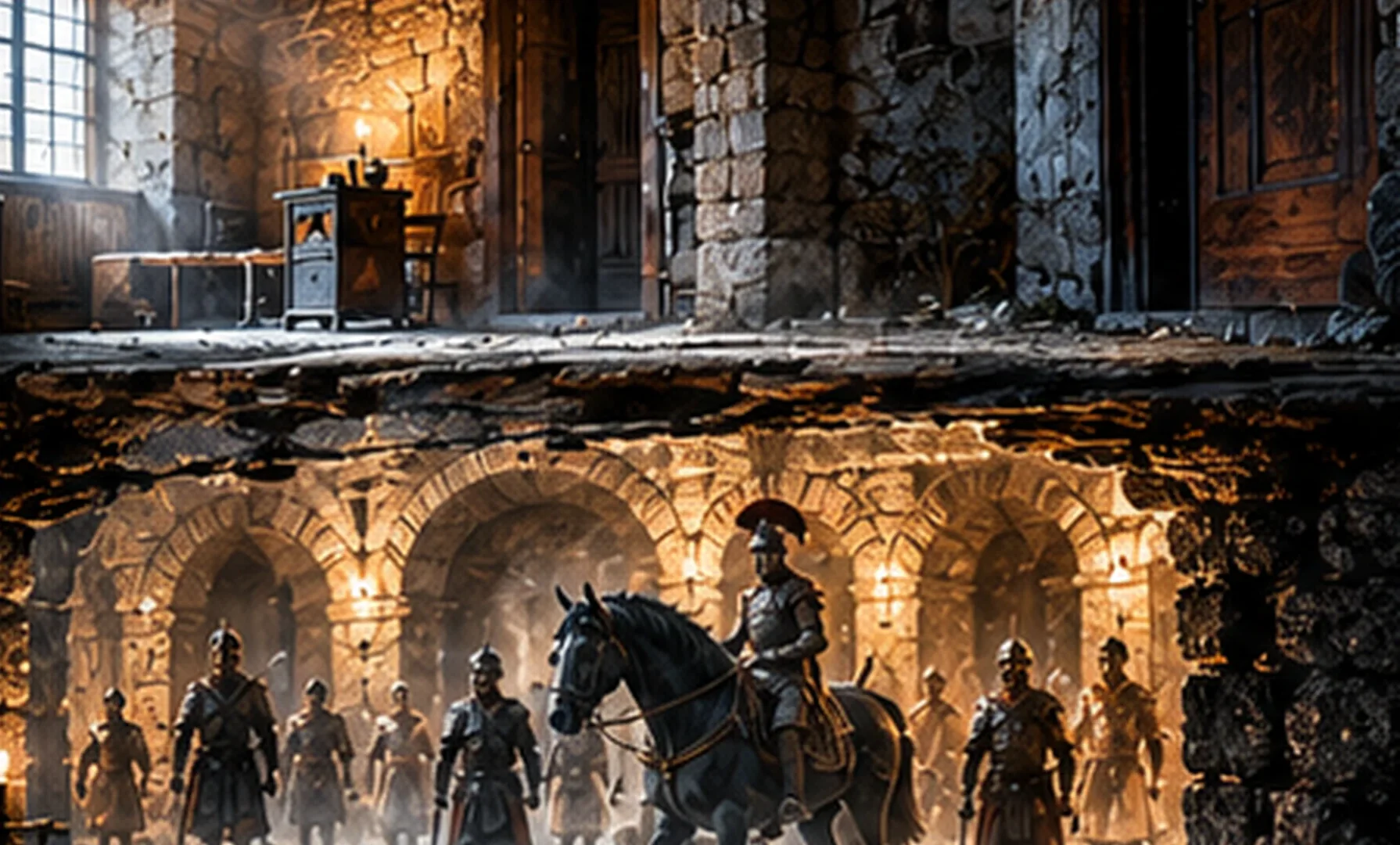
Behind him came another soldier on horseback.
Then more.
Two abreast.
A procession.
Harry later described around twenty soldiers moving through the cellar before disappearing through the wall on the opposite side.
And there was one very peculiar detail.
He could not see their lower legs.
The soldiers appeared only from approximately the knees upward.
It looked as though they were walking through the floor.
Source: National Trust — The ghosts of Treasurer’s House (opens in a new tab)

Martindale said… According to the National Trust’s account…
Years later, archaeology confirmed something beneath Treasurer’s House.
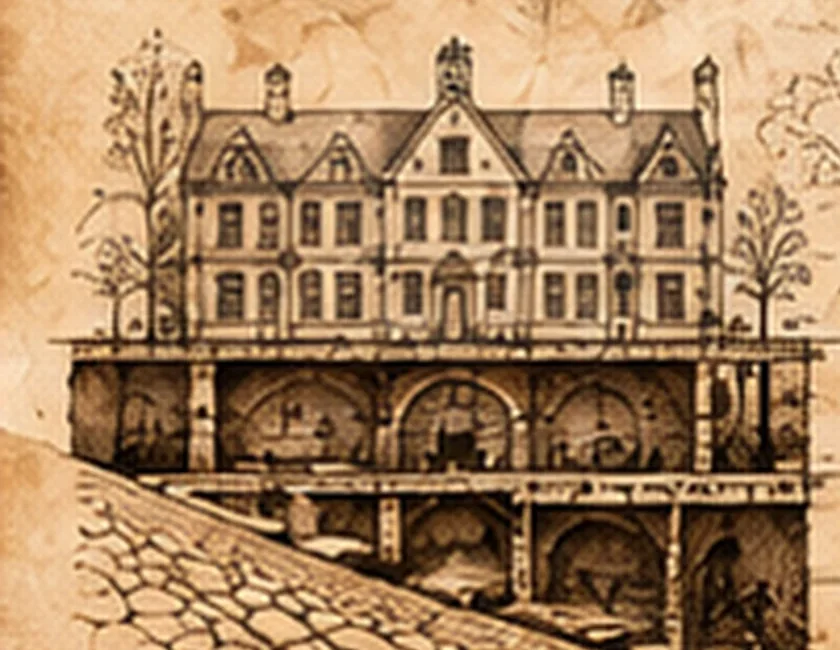
The house sits close to what was the outer wall of the Roman legionary fortress of Eboracum, and its foundations are built upon the remains of the ancient Roman city.
A major Roman road ran through the area, and excavations under the basement have revealed the edge of it.
Archaeological deposits associated with the fortress lie below the modern ground level. The National Trust describes the Roman ground level as a little below the cellar floor.
In other words:
The modern building is sitting above an older Roman landscape.
So the soldiers Harry said he couldn’t see below the knees?
In the story, they appeared to be walking at an older ground level.
That is exactly the sort of detail that makes a mystery grow teeth.
It does not prove Harry saw Roman ghosts.
Archaeology discovering a Roman road beneath a Roman city is not supernatural evidence.
But it is the kind of coincidence that keeps people telling the story seventy years later.
Source: National Trust — History of Treasurer’s House (opens in a new tab)
According to the National Trust’s own account of the property’s ghost stories, reports involving Roman figures were not limited to Harry.
An earlier visitor supposedly encountered a Roman soldier in the cellar.
The house’s warden reportedly hinted that he had seen something himself.
Housekeeper Joan Mawson later said she heard horses approaching near the cellar before experiencing what she described as Roman soldiers and horses passing by.
These accounts were recorded at different times and should be treated as witness stories—not laboratory observations.
Memory changes.
Stories spread.
People influence one another.
Details become polished through retelling.
But this is exactly what makes repeated-location stories interesting.
The claim isn’t simply:
“Someone once saw a ghost.”
It’s:
Why do certain places keep producing similar kinds of stories?
Source: National Trust — The ghosts of Treasurer’s House (opens in a new tab)
1972
Now we arrive at the name most people eventually encounter when researching this idea.
Stone Tape Theory.
It sounds wonderfully official.
Almost geological.
As though somebody discovered it in a laboratory beside continental drift.
They didn’t.
The phrase became associated with a 1972 BBC television ghost story.
Nigel Kneale’s The Stone Tape follows a team of electronics researchers working in an old building.
They encounter what appears to be a haunting.
Eventually they begin to suspect that the building material itself has somehow stored an event from the past.
The haunting isn’t necessarily a conscious spirit.
It’s information.
Recorded in the structure.
Played back.
The program aired on Christmas Day 1972 and became enormously influential in British paranormal culture.
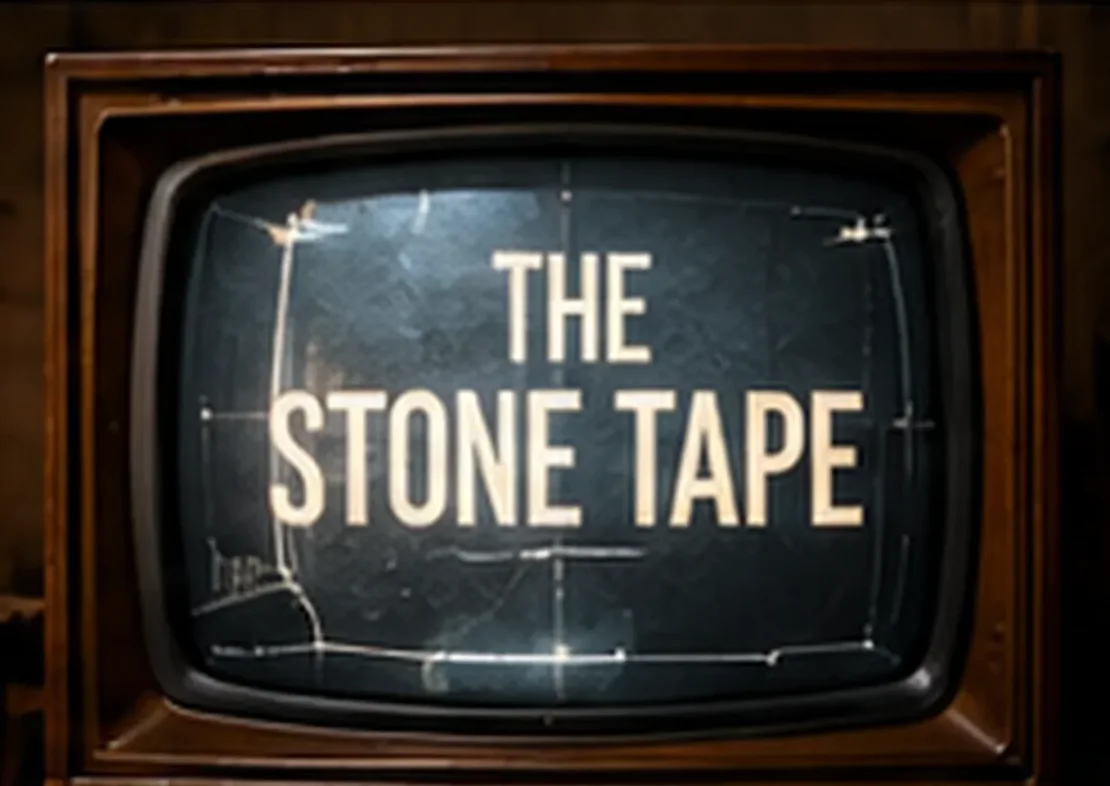
“Stone Tape Theory” sounds like an old scientific theory.
Its famous name comes from a 1972 television ghost story.
The television show did not prove the concept.
It dramatized it beautifully.
And the idea stuck.
Source: BFI — 10 great TV ghost stories (opens in a new tab)
Ah.
Here comes quartz.
Because whenever Stone Tape Theory appears, somebody eventually says:
“But old buildings contain quartz.”
And that sounds promising because quartz genuinely does something fascinating.
Quartz is piezoelectric.
Apply mechanical pressure to certain crystals and an electrical effect can be produced.
Apply an electrical voltage and the crystal can physically deform.
That ability to convert between mechanical and electrical energy is extremely useful.
Quartz resonators help keep time.
They’re used in watches, clocks, electronics and measurement equipment because they can oscillate at remarkably stable frequencies.
All of that is real.
Source: NIST — quartz and piezoelectricity (opens in a new tab)

But here is the sentence we need to keep taped to the wall:
Piezoelectric is not the same thing as psychic VHS.
Quartz responding electrically to pressure does not demonstrate that a stone wall can spontaneously:
For that to work as a recording system, we would need some demonstrated process of:
How would an event be written into the material?
How would that information be held?
How would it survive for centuries?
What would trigger it to be read back?
How would it become a perceived figure or sound?
No known Stone Tape mechanism has demonstrated that chain.
So yes:
Matter can hold information.
Therefore your grandmother’s kitchen wall recorded Thanksgiving 1987.
The first statement is true. The second does not automatically follow.
And frankly, Thanksgiving 1987 may be better left unplayed.
This may be where the story gets even more interesting.
Researchers have actually taken people into reputedly haunted places and asked them to report unusual experiences.
Psychologist Richard Wiseman and colleagues conducted studies at Hampton Court Palace and the South Bridge Vaults in Edinburgh.
Participants walked through the locations and reported where they experienced sensations they considered unusual.
People reported significantly more unusual experiences in areas already associated with haunt reports.
Here’s the intriguing part:
That pattern wasn’t simply explained by participants already knowing which areas had haunted reputations.
The locations of some experiences also correlated with ordinary environmental differences, including lighting and variations in local magnetic fields.
The researchers concluded that at least some alleged haunting experiences could result from people responding to normal environmental factors around them.
A correlation is not a cause: the studies show an association between places, conditions and reports, not that any one factor produces a haunting.
Source: Wiseman et al., British Journal of Psychology (opens in a new tab)
Think about what an old building can contain.
Dim light. Uneven floors. Drafts. Cold pockets. Odd acoustics. Low-frequency vibration. Air-quality differences. Mechanical systems. Unexpected reflections. Narrow passages. Rooms built at proportions we’re no longer accustomed to.
Our brains are constantly taking in information that never reaches conscious thought.
And when researchers reviewed decades of studies concerning allegedly haunted environments, several factors kept appearing: lighting, air quality, temperature, infrasound, electromagnetic fields, and physical cues built into the environment itself.
But here’s another important piece:
The evidence has been inconsistent.
Dim light and unexpected reflections.
Evidence: inconsistentCold pockets.
Evidence: inconsistentMoving air in old, uneven structures.
Evidence: inconsistentOdd acoustics and echoes.
Evidence: inconsistentLow-frequency vibration.
Evidence: inconsistentAir-quality differences and mechanical systems.
Evidence: inconsistentVariations in local magnetic fields were reported in one study.
Evidence: inconsistentUneven floors, narrow passages, unfamiliar proportions.
Evidence: inconsistentThe story we carry in with us.
Evidence: inconsistentA review covering 66 studies found mostly null, weak or mixed results.
There is currently no single environmental variable that explains “haunted” experiences as a category.
Source: “Things That Go Bump in the Literature” (Frontiers in Psychology, via PMC) (opens in a new tab)
So we don’t get to replace:
“Ghosts did it.”
with:
“Infrasound did it.”
and declare victory.
Reality is messier than either answer.
There is another kind of place memory that requires no paranormal mechanism at all.
Human beings attach stories to places.
A room becomes the room where she died.
A staircase becomes the staircase where footsteps are heard.
A hotel becomes the haunted hotel.
People visit.
They feel something.
They tell somebody else.
The next person arrives already alert.
They notice the floorboard.
The draft.
The shadow.
The sudden feeling of being watched.
Another story joins the first.
Soon the place has a personality.
Perhaps sometimes the building isn’t storing the memory.We are.Collectively.And we keep putting it back.
That doesn’t make individual experiences imaginary.
Expectation can change perception without anybody lying.
Environment can affect us without our knowing why.
History can make a location emotionally powerful.
And occasionally someone reports something that doesn’t fit neatly into any of those boxes.
Which is exactly why this remains a Little Mystery.
Background: atmospheric illustration of old books — not historical evidence
Depends what we mean by remember.
Walls hold soot. Floors hold wear. Buildings contain repairs, scratches, paint layers and fingerprints of previous lives. Archaeological layers preserve roads, foundations, tools, bones and ordinary rubbish for thousands of years. That is matter carrying information about its past.
Architecture, acoustics, lighting, air, temperature, expectation and other environmental conditions can influence perception and emotion.
We build monuments for exactly this reason. Battlefields mean something because history happened there. Childhood homes can trigger memories instantly. A smell can pull twenty forgotten years into the present.
Quartz physics does not establish it. No accepted mechanism currently explains how such a recording would be encoded, stored and decoded.
Science does not require us to pretend we already know everything. It only requires us not to call an unanswered question an answer.
What could be behind these experiences? Explore the main possibilities, and see what each one explains — and what it doesn’t.
A place somehow records an event and replays it later.
These possibilities are not equally supported. Some are research questions; others are speculative or paranormal ideas that have not been demonstrated.
There’s always another possibility. Open the card to explore a less conventional idea.
We usually picture memory as something kept inside a head. But people also keep it in notebooks, photographs, family recipes, monuments, songs and the stories told about a house. Perhaps, the thought goes, memory is less a thing in one place than something that passes back and forth between people and the places they share.
This is a philosophical curiosity, not a scientific claim. We are not offering evidence that buildings remember. We include it because it reframes the question: it asks where remembering happens, rather than whether stone can do it alone.
Reader poll · sample
This is a sample reader poll. Answers are not saved.
So what happened beneath Treasurer’s House?
Was Harry Martindale experiencing something created by an unusual environment?
Did memory and later storytelling reshape an extraordinary experience?
Was there some mundane event that became stranger through retelling?
Was his experience connected somehow to the ancient Roman landscape under his feet?
Was it what paranormal researchers would call a residual haunting?
Or are we trying to force something genuinely strange into categories that are still too small?
I don’t know.
And I like this mystery better because I don’t know.
Because maybe places don’t remember the way people do.
Maybe they remember through scratches, foundations, temperature, echoes, stories and the nervous systems of the people who walk through them.
Maybe sometimes we carry the memory for the place.
And maybe every once in a while, someone walks into a cellar in York…
hears a trumpet…
looks toward a wall…
and sees twenty men walking along a road that disappeared beneath the city centuries ago.
A place can hold history.
The mystery is whether it can hold experience.
Have you ever walked into a place and felt something before you knew its story?
Explore More Little MysteriesBackground: atmospheric illustration of a view toward York Minster — not a photograph
Sources & further reading
Every image on this page is an editorial illustration, not a historical photograph, documentary image or archaeological evidence. Witness accounts are presented as accounts. Speculation is labelled as such. Unexplained does not mean supernatural.